

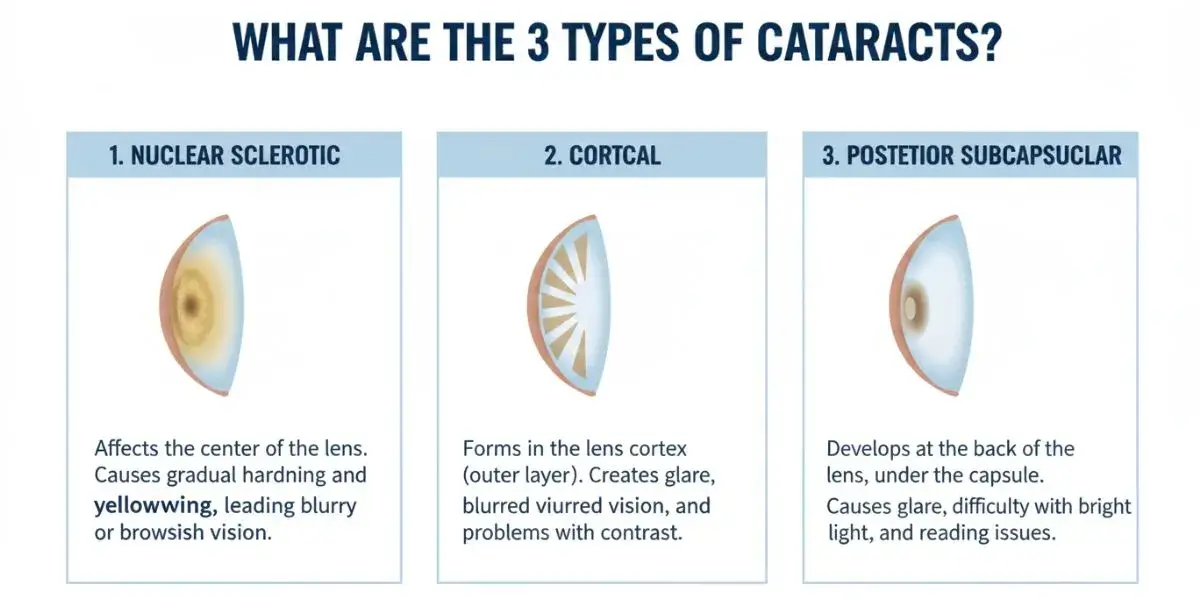
What Are the 3 Types of Cataracts?
An eye disorder that is prevalent in millions of people all over the world, particularly as they age is cataracts. Although it is very widespread, most of the patients still lack a complete understanding on what causes cataracts and what are the 3 types of cataracts that can differently impair the vision of the patients. Education of patients in eye care centre such as The Eye Care Clinic is given importance as it enables people to be aware of the symptoms and seek early treatment.
A cataract is not formed in a short period of time. It is a gradual process whereby the transparent lens of the eye gradually grows cloudy which has an effect on the manner in which light gains access into the eye and to the retina. Eventually, this haze may disrupt normal day activities like reading, driving, face recognition, and even when one is doing simple things at home. Learning the various varieties of cataracts makes patients understand why people can have different types of symptoms and why the time to treat cataracts can vary.
Learning about Cataracts: the way of making the vision cloudy
Human eye is adapted in a camera-like manner. The light enters the eye via cornea, pupil and proceeds via the lens until it reaches the retina. The lens is usually transparent and soft, which enables it to focus the light sharply. The proteins within the lens however start breaking down and clumping together as we grow older or because of some medical conditions. This happens to make it cloudy, a phenomenon referred to as a cataract.
Cataracts may also occur in one or both eyes, but does not transfer from one eye to the other. The rate at which a cataract advances varies based on a number of factors, some of which include; age, lifestyle, medical history and the type of cataract one is having. That is why it is so significant to learn about the 3 types of cataracts that could be used by patients and eye specialists alike.
Why it is Important to know what sort of Cataract one has?
All types of cataracts do not act in the same manner. Others develop gradually over a long period of time whereas some may deteriorate in a few months. Some of them primarily impact on distance vision and some of them disrupt reading or have a serious case of glare even during the initial stages. The place where the cataract is located in the lens is what causes the symptoms to manifest and the speed at which the vision is impaired.
In specialized eye care centre, the cataract type is also used to assist the doctor in choosing the most appropriate monitoring schedule and the appropriate time to conduct surgery. It also enables the patient to be aware of the causes of certain visual issues that they are undergoing.
What are the 3 types of Cataracts?
Three main types of cataracts are distinguished depending on the place of their location in the lens:
- Nuclear Cataracts
- Cortical Cataracts
- Posterior Subcapsular Cataracts
All types influence vision in different ways and also exhibit a different pattern of development. We shall see each one in particular.
1. Nuclear Cataracts: The Age-Registered Cataract
The cataracts in the eye that are formed at the middle of the lens are called nucleus. This is the most prevalent form of cataract and it has a strong relationship with ageing. As a matter of fact, when individuals discuss age related cataracts, they are actually referring to nuclear cataracts.
The development of Nuclear Cataracts
Lens is inherently more rigid and stiffer at old age. The proteins within the nucleus of the lens start to get hard and turn color with time. At first, it can only produce mild visual changes. The lens can acquire a yellowish color that can interfere with the perception of color to some extent. The lens also has a possibility of turning brown as the cataract advances and this then limits the quantity of light that gets to the retina.
Nuclear Cataracts Symptoms
Nuclear cataracts may gradually change and the patient may notice:
- Diffuse or foggy vision of distance.
- Finds it hard to see on the road particularly at night.
- Hypersensitivity to glare of headlights.
- Darkening or loss of colors.
Interestingly, others undergo a short-term change in the near vision, also referred to as second sight. Although this might appear as an advantage, it is considered a temporary change which often is the initial signs of the development of cataracts.
Progression and Impact
Nuclear cataracts are slow moving and in most cases, they develop over a period of years. The fact that the changes are progressive allows many patients to adapt without being aware of the fact that their vision has worsened. That is why, it is so imperative to conduct eye examinations regularly, particularly in case of people, who have passed the age of 40.
2. Cortical Cataracts: The Spoke-Like Cataract
Cortical cataracts are also formed in the outer part of the lens referred to as cortex. Cortical cataracts occur at the periphery and move towards the centre as compared to nuclear cataracts that occur at the centre of the lens.
How Cortical Cataracts Form
This kind of cataract begins with small white or wedge like opacities at the edges of the lens. Gradually, these opacities increase in size and reach the centre thereby affecting light passage. Due to the shape, cortical cataracts may look like spokes of a wagon.
Cortical Cataracts Symptoms
Cortical cataracts in the patient can be characterized by:
- Greater glare, particularly during the sunny days.
- Halos around lights
- Problem in estimating distances or depth.
- Lowered visual acuity.
These symptoms may render operations like driving, especially at night or during the sunrise and sunset to be quite difficult.
Risk Factor
Diabetes, long exposure to ultraviolet radiation, and some metabolic malfunctions are some of the common issues that cause cortical cataracts. They can grow faster than nuclear cataracts and in fact, be of great consequence even at earlier stages to visual comfort.
3. Posterior Subcapsular Cataracts: Rapid and Disruptive
The posterior subcapsular cataracts are developed behind the lens, just below the lens capsule. Even though they are not as prevalent as nuclear or cortical cataracts are, they may be especially problematic because of the way they disrupt the incoming light in the eye.
The reason why posteriors subcapsular cataracts are different
Since this form of cataract is formed directly on the way of incoming light, a modest size of cataract is sufficient to produce visible visual defects. It tends to develop very quickly, even in a few months.
Posterior Subcapsular Cataracts Symptoms
Commonly includes:
- Lack of ease in reading or doing close-up work.
- Extremely bright light or sun rays.
- Halos around lights
- Poor vision in bright conditions.
The symptoms are abrupt and can escalate rapidly, and thus patients will look to medical attention earlier.
Risk Factors
Subcapsular cataracts are observed more in patients with diabetes, users of steroid drugs over a long period, and those with high levels of nearsightedness. They can also be developed following eye trauma or inflammation.
Comparison of the 3 Types of Cataracts
It would be easier to see the 3 types of cataracts once the characteristics are compared:
- The cataracts that result in nuclear cataracts are primarily distance affecting and slow progressing.
- The cortical cataracts give rise to glare and contrast difficulties which are usually seen in bright light.
- The cataracts are posterior subcapsular and disrupt the near vision.
All types need close monitoring and a treatment plan to be designed individually.
How Cataracts Are Diagnosed
Cataracts are diagnosed by means of thorough eye examination. The eye specialists also measure visual acuity; observe the lens under slit lamp and the effect of cataracts on light sensitivity and contrast. Advanced diagnostic instruments can be used to estimate the nature, site and severity of the cataract.
If it is diagnosed at an early stage, basic lifestyle changes are suggested by the doctors and then can keep a track of the progress and decide on when can surgery be opted.
Cataract Treatment
Symptoms can be managed at an early stage by setting up better lighting, prescribe eyeglass, or by using anti-glass lenses. Nevertheless, cataracts cannot be treated using medications and eye drops. Cataract surgery is the only sure form of treatment.
The natural lens becomes cloudy during surgery which is removed and replaced with clear artificial intraocular lens. Contemporary surgery on cataracts is safe, effective, and successful in a high level to restore the sight.
Conclusion
Many people are young and growing old, and cataracts are a normal process of growing old which does not necessarily result in being permanently blind. Knowing the 3 types of cataracts -nuclear, cortical, and posterior subcapsular- is also important in order to realize the symptoms, know your diagnosis, and make correct decisions regarding treatment.
Eye examinations, safety glasses, and seeing the doctor can ensure that you have your vision and healthy eyes to enjoy in the next few decades. When you start experiencing some alterations in your vision, the initial step on the way of clear and comfortable sight is visiting an experienced eye specialist.
Book Consultation
-
- Phone :
- Email :
- Address :
-
- +91 91199 01070
- [email protected]
- Jaishankar Building, 2/176, opposite Shiv Murti, Sector 2, Vikas Nagar, Lucknow, Uttar Pradesh 226022